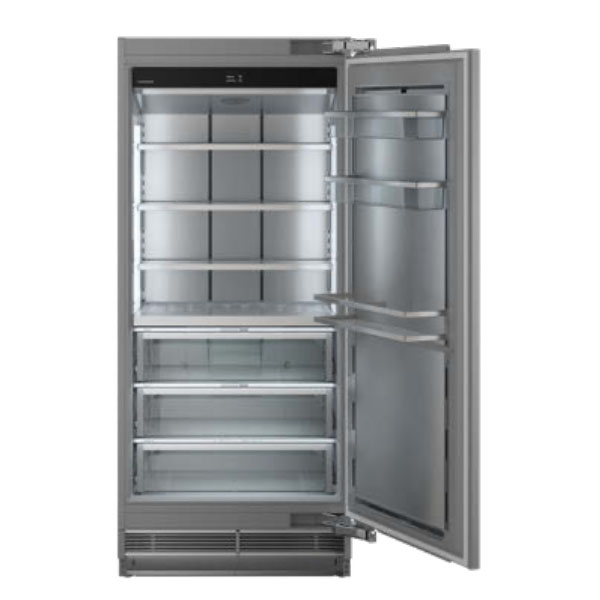
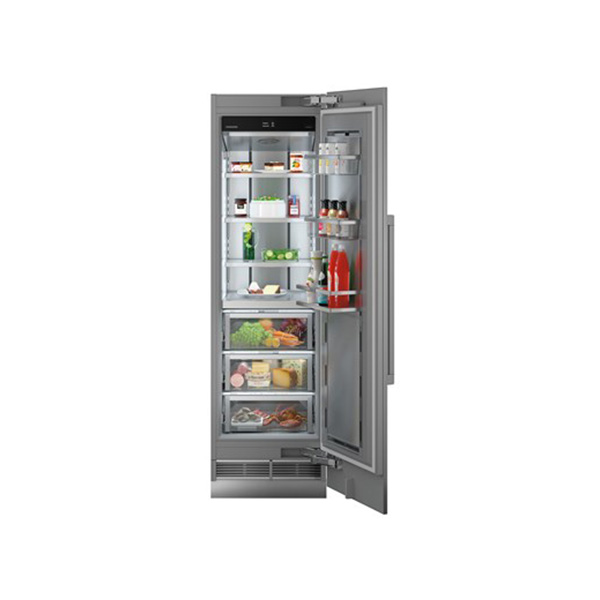
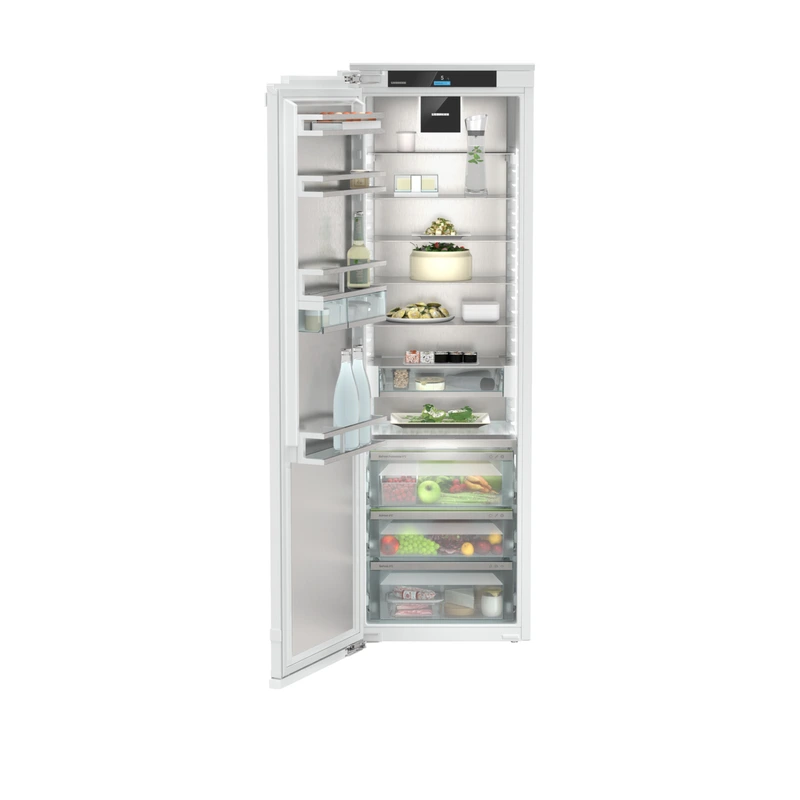
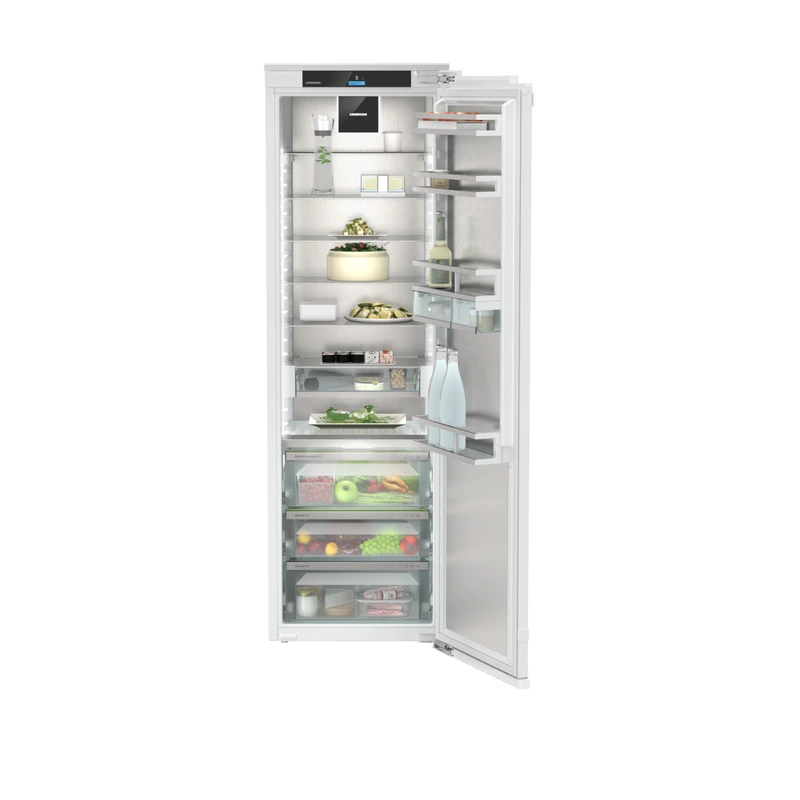
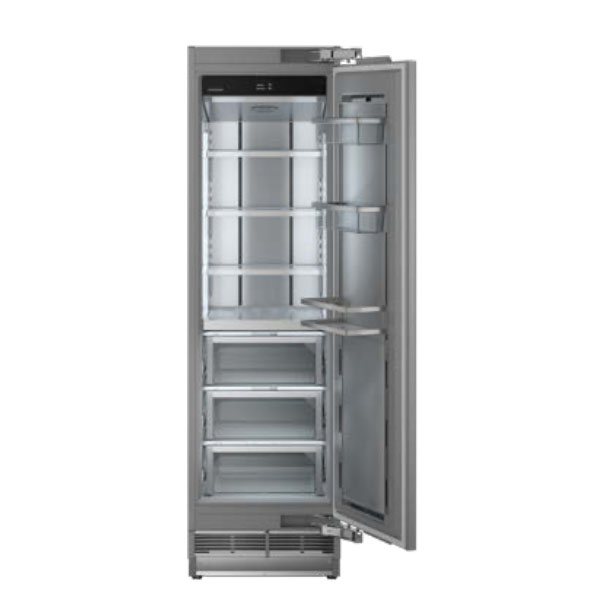
| Model | ERBdi 9971 (door hinge left) / ERBdi 9970 (door hinge right) |
|---|
| Appliance type | Refrigerator |
|---|
| Energy efficiency class | Not stated in source |
|---|
| Energy consumption | 185 kWh/year – 0.506 kWh/24 h |
|---|
| Noise output / noise class | 32 dB(A) / B |
|---|
| Total volume* | 542 litres |
|---|
| Refrigerator compartment volume | 308 litres |
|---|
| BioFresh compartment volume | 234.8 litres |
|---|
| Storage shelves (total/height-adjustable) | 4 / 3 |
|---|
| Door racks | 3 |
|---|
| BioFresh/BioFresh-Plus safes with LED lighting | 3 |
|---|
| Electronic control system | InfinitySwipe |
|---|
| Automatic SuperCool | Yes |
|---|
| Refrigerator temperature range | +2 °C to +7 °C |
|---|
| Defrosting | Automatic |
|---|
| Interior lighting | InfinityLight |
|---|
| Integrated water dispenser | InfinitySpring, with water filter |
|---|
| Door hinge | Reversible** |
|---|
| Appliance dimensions (H/W/D) | 212.6 cm / 90.6 cm / 61 cm |
|---|
| Recess dimensions (H/W/D) | 213.4 cm / 91.4 cm / 63.5 cm |
|---|
| Net weight | 200.0 kg |
|---|
| Voltage / connected load | 220–240 V~ / 1.5 A |
|---|
| Inset door panel dimensions | A = 400 mm; B = 12.5 mm; C = 962 mm |
|---|
| Overlay door panel dimensions | A = 406 mm; B = 12.5 mm; C = 975 mm |
|---|
| Panel thickness | Minimum 16 mm* / maximum 25 mm |
|---|
| Maximum panel weight | 40 kg |
|---|
| Unit depth (overlay installation) | 635 mm |
|---|
| Unit depth (inset installation) | 635 mm + thickness of custom panel |
|---|
| Ambient climate class | SN–T (10 °C to 43 °C) |
|---|
| Plinth panel minimum height | 102 mm (adjustable feet raised by 6–8 mm) |
|---|
| Maximum plinth panel height adjustment | Adjustable feet can be raised by up to 19 mm |
|---|
| Mains cable exit point | 19 mm from the left; 127 mm from the floor; free length 2.5 m |
|---|
| Recess for cable and water line | Depth 25 mm; height 140 mm across full appliance width |
|---|
| Refrigerant circuit tightness / safety | Refrigerant circuits checked for tightness; appliances meet applicable safety regulations |
|---|
* Total volume rounded in accordance with Regulation (EU) 2019/2016.
** Door hinge reversal must be carried out by authorised Liebherr Monolith customer service.
Installation space and recess
The floor must support the weight of the appliance plus approximately 218 kg to 544 kg of food, depending on model. The surface must be level, even and made of a hard, rigid material. The floor in the installation area must be at the same height as the rest of the room, and the appliance must be underlaid or levelled to floor level so that ventilation openings remain clear. Recess dimensions at the installation location must be correctly measured and the power socket positioned correctly. Appliance height including packaging and pallet is 2285 mm.
For secure installation, top and carcass walls must line up flush with the appliance at a depth of at least 102 mm from the outside edge and be at least 16 mm thick. Because the recess is partially visible when the door is opened, the inside surfaces should match the unit surface at the top and sides with a minimum depth of 76 mm. Monolith appliances are designed for flush installation in units with a depth of 635 mm using stainless-steel panels or customer-specific panels.
Door panels and plinth
Custom door panels must not exceed the maximum permitted panel weight for the door hinge; other materials made of wood with a maximum thickness of 25 mm can be used if this limit is respected. The scope of supply includes a decorative trim to cover the gap between the appliance and side walls of the fitted unit. The depth of Monolith appliances is 610 mm, allowing installation in standard 610 mm units or deeper 635 mm cut-outs.
The appliance is ventilated entirely via the plinth panel. Door panels must close at least 102 mm above the floor and the grill in the plinth panel must not be obstructed. Wall spacers/air separators supplied with the appliance must be fitted to separate warm outgoing air from incoming fresh air. Liebherr offers an optional 102 mm high stainless-steel plinth panel in widths matching Monolith models and Side-by-Side combinations from 45.7 cm to 182.8 cm.
Adjustable feet are fully retracted at the stated minimum appliance height. Once positioned in the recess, the appliance is raised from the front so it contacts the anti-tipping device. To achieve a plinth panel height of 102 mm, the feet must be raised by 6–8 mm; they can be raised by a maximum of 19 mm if a higher plinth panel is required. Installations behind the appliance are not possible.
Side-by-Side and positioning options
Monolith appliances can be installed as stand-alone units with the hinge on the left or right. When sizing a fitted unit, the thickness of the door panel and handle must be considered. To prevent the door or handle colliding with adjacent walls or kitchen elements, a minimum spacing of 76 mm is required for a door opening limited to 90°.
Appliances may be installed Side-by-Side in a single fitted unit or in separate units. A Side-by-Side set is required if spacing between appliances is less than 102 mm or if a dividing wall between separate units is thinner than 102 mm. For back-to-back door positioning, a minimum spacing of 154 mm is necessary. When combining three units, different configurations using Side-by-Side sets or carcass sides of at least 16 mm thickness are possible; some arrangements can lead to door collisions.
Door spacing and opening angle
To avoid the doors and handles bumping into adjacent cupboards, work surfaces, walls or other elements, the appliance must be positioned so that sufficient spacing is maintained. The factory door opening angle is 115°, but this can be limited to 90° by inserting the supplied 90° door opening limiter (stable peg) into the hinge. Additional measures include reducing door panel thickness if greater than 19 mm, repositioning adjacent elements or using a stopper.
Electrical safety
The appliance must only be operated using alternating current, within the permitted voltage and frequency for the relevant country. Power sockets must be earthed and electrically protected, must not be located behind the appliance and must remain easily accessible for disconnection. A separate circuit is recommended to prevent defrosting or food spoilage caused by failures from other appliances.
There is a risk of fatal electric shock if the appliance is connected to unearthed power sockets. The appliance must not be connected using an extension cable, multi-socket or inverter, due to risks of overheating, imperfect sine wave voltage and fire hazards.
Water connection, InfinitySpring and IceMaker
Appliances fitted with InfinitySpring or an IceMaker must be connected to a water supply with pressure between 2.8 and 6.2 bar. Only the supply hose delivered with the appliance may be used. A shut-off valve must be installed between the hose line and mains water supply, positioned so it is not behind the appliance. Connection to the water supply must only be undertaken by a trained and licensed plumber, and water quality must comply with local drinking water regulations.
The IceMaker is intended solely for producing ice cubes in normal household quantities and must only be used with suitable water. All repairs and work on InfinitySpring or IceMaker must be carried out by customer service employees or other trained individuals. All devices and systems used to supply water must meet applicable regional provisions. Appliances with InfinitySpring or IceMaker contain a water filter in the front section of the base; it must be replaced regularly, and an InfinitySwipe alarm indicates when replacement is due.
Ambient temperature and operation
The appliance is intended for refrigerating, freezing and storing food and for making ice (if equipped accordingly). It is designed for operation within the ambient temperature ranges defined by its climate class SN–T (10 °C to 43 °C). It must not be operated outside these ranges to ensure optimal cooling performance.
Secure mounting and anti-tipping device
To prevent the appliance tipping over after installation, the anti-tipping device positioned at the base must be secured to the floor or wall. The appliance should be left to stand for one hour in the installation location before switching on, allowing fluids in the coolant and lubrication system to distribute evenly.